
Staff
Demand and deployment across all trades.
- Security personnel
- Stewards
- Admission staff
- Medical staff
- Cleaning
- Catering
- Parking staff
- Technology
- Reserve teams
AI operating system for events
Event Guardian combines AI-powered capacity planning, live monitoring, weather data, drones, IoT sensors and operational dispatch in one shared platform.
Separate spreadsheets, radio channels and responsibilities become one shared, forward-looking situational picture.
One platform instead of many silos
Event Guardian brings together data, capacities and decisions — from the first planning step to the post-event review.
Calculate scenarios, capacities and risks before the event.
Everyone in charge sees the same, up-to-date picture.
Concrete recommended actions instead of mere status updates.
Every event improves the planning of the next.
Today's problem
Spreadsheets, radio channels and individual areas of responsibility only know their own slice. Yet almost all areas influence one another.
Interacting areas
A disruption in public transport can lead to a delayed arrival wave, overloaded entrances, increased parking demand and additional staffing needs.
Event Guardian brings these interdependencies together in one shared system.
Event lifecycle
Event Guardian covers the entire lifecycle — and closes the loop by feeding lessons learned back into planning.
AI-powered capacity planning
The AI combines historical data, forecasts and contextual information into robust capacity scenarios — for every resource that keeps an event running.
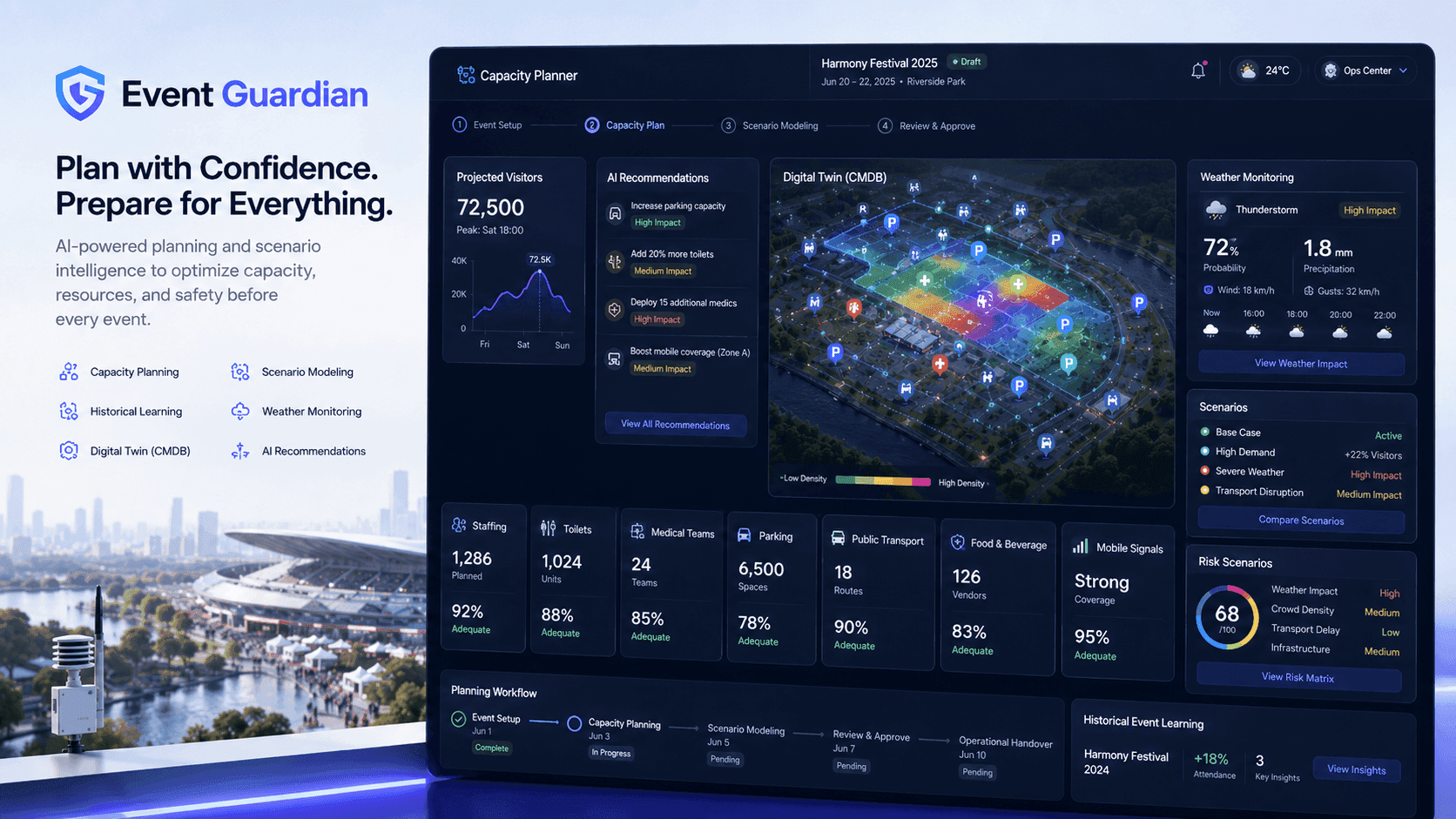
The AI processes
Scenarios
Baseline scenario
Expected regular operation as a planning basis.
High-load scenario
Peak crowds, rush hours and maximum utilisation.
Weather scenario
Effects of heat, storms or heavy rain.
Traffic disruption
Delayed arrival waves and congestion.
Technical failure
Failure of power, network or key systems.
Staff shortage
Short-notice staff shortages and reallocation.
Safety scenario
Heightened threat level and escalation.
Example capacity cards
Staff
Demo~ 180 personnel
across all trades
Toilets
Demo~ 120 units
incl. accessible
Medical teams
Demo6 teams
+ 2 in reserve
Car parks
Demo~ 3,400
across 4 areas
Public transport
DemoIncreased service frequency
Coordination with transit operator
Food and beverages
DemoResupply
demand-driven
Mobile network
DemoBottleneck risk
Entrance areas
Wi-Fi
Demo12 zones
Load monitoring
Power
DemoLoad reserve
Backup power checked
Water
DemoRange
per supply point
All figures are demonstration and scenario values for illustration — not customer data and not proof of performance.
Product film
A concise overview of how planning, the live situational picture and dispatch work together in Event Guardian.
Organisational capacities
For every organisational area, Event Guardian provides its own, connected view of capacity.
Tip: click a tile for a product preview of each area.
Demand and deployment across all trades.
Count, distribution and condition.
Teams, stations and peak periods.
Technical capacities
Technical infrastructure, too, is treated as plannable capacity — with a particular focus on mobile network coverage.
Mobile network
Event Guardian connects expected visitor numbers, event times and location with available mobile network capacity, current network load and historical load data.
Input variables
Possible measures
Further technical capacities
Event Guardian doesn't just show readings — it assesses what they concretely mean for stages, areas and operations.
Data sources
What is assessed
A thunderstorm cell is expected to reach the site in 40 minutes. The outdoor stage and the western visitor area are affected. We recommend securing temporary structures, preparing a partial evacuation and specifically informing the teams in charge.
Event CMDB and digital twin
The digital twin is a continuously updated, virtual replica of the site and its operations.
In this context, the event CMDB (Configuration Management Database) is a central register of all resources, locations, capacities and dependencies relevant to running the event.
The spatial framework of the event.
Mobile and fixed equipment.
Teams with roles and availability.
The technical infrastructure of operations.
Dependencies
One entrance requires:
If a component fails, Event Guardian shows the potential impact on visitor flow, waiting times and safety.
Live Operations Center
The Live Operations Center brings together all operationally relevant signals — and translates them into concrete, traceable recommendations.
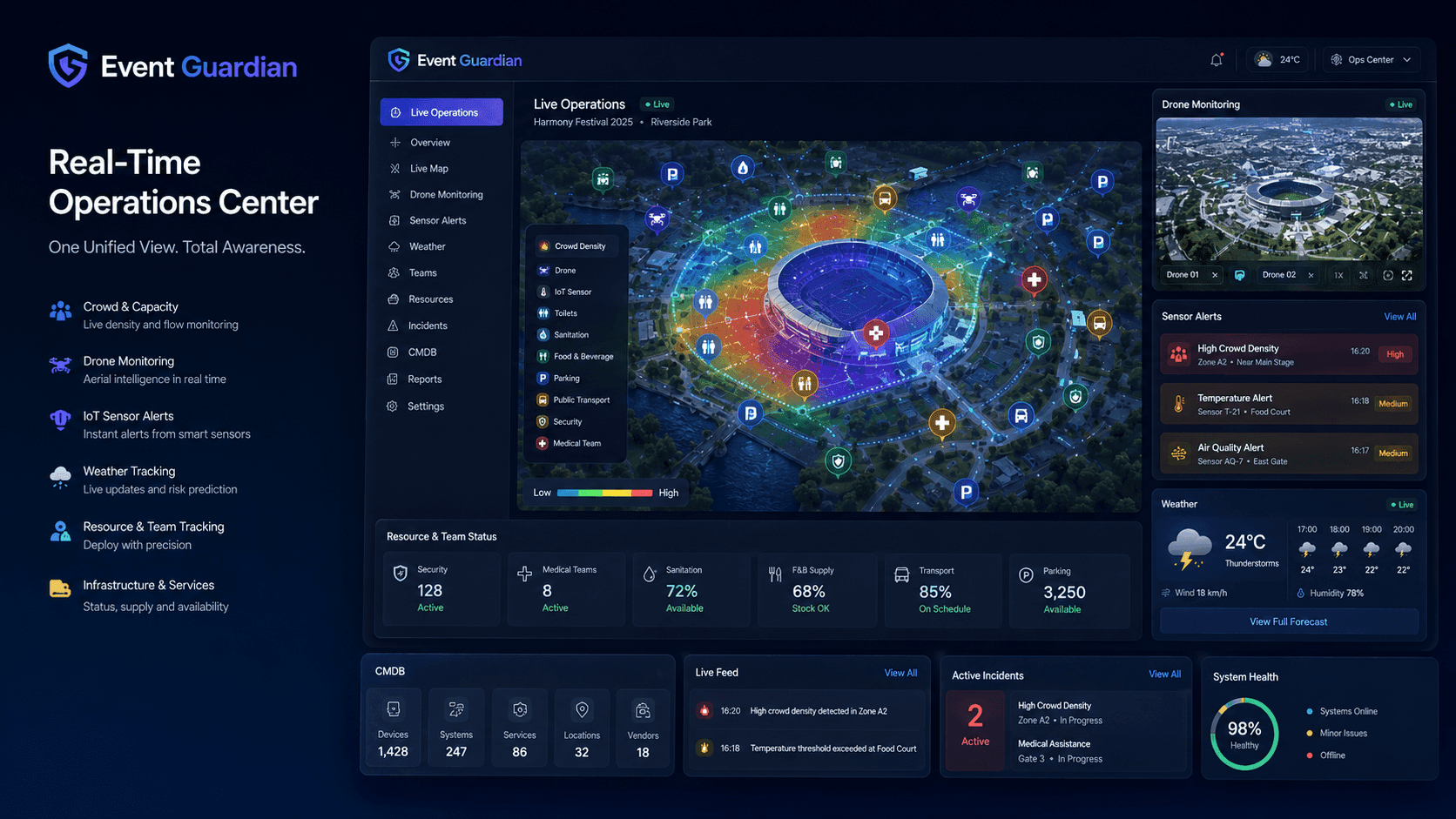
Signals in the situational picture
Instead of a plain alert
„West entrance is overloaded.“
The wait at the western entrance is expected to exceed 30 minutes within the next 20 minutes. The north entrance has spare capacity. We recommend relocating six security staff and actively guiding visitors.
Responsibility stays with humans
Drone monitoring
Drones provide aggregated movement and situational information for areas that are hard to see from the ground.
Support with
Clear limits
IoT and sensors
Connected sensors are part of the digital twin and make supply, cleaning and waste disposal controllable.
Measure consumption and remaining range.
Capture usage, materials and defects.
Assess reports from many sources.
Manage containers and waste disposal as needed.
At the current rate, the water supply in the western food area will last about another 50 minutes. The southern area has sufficient reserves available.
Visitor app
The visitor app can be used without a personal account and helps with orientation, information and emergency reporting.
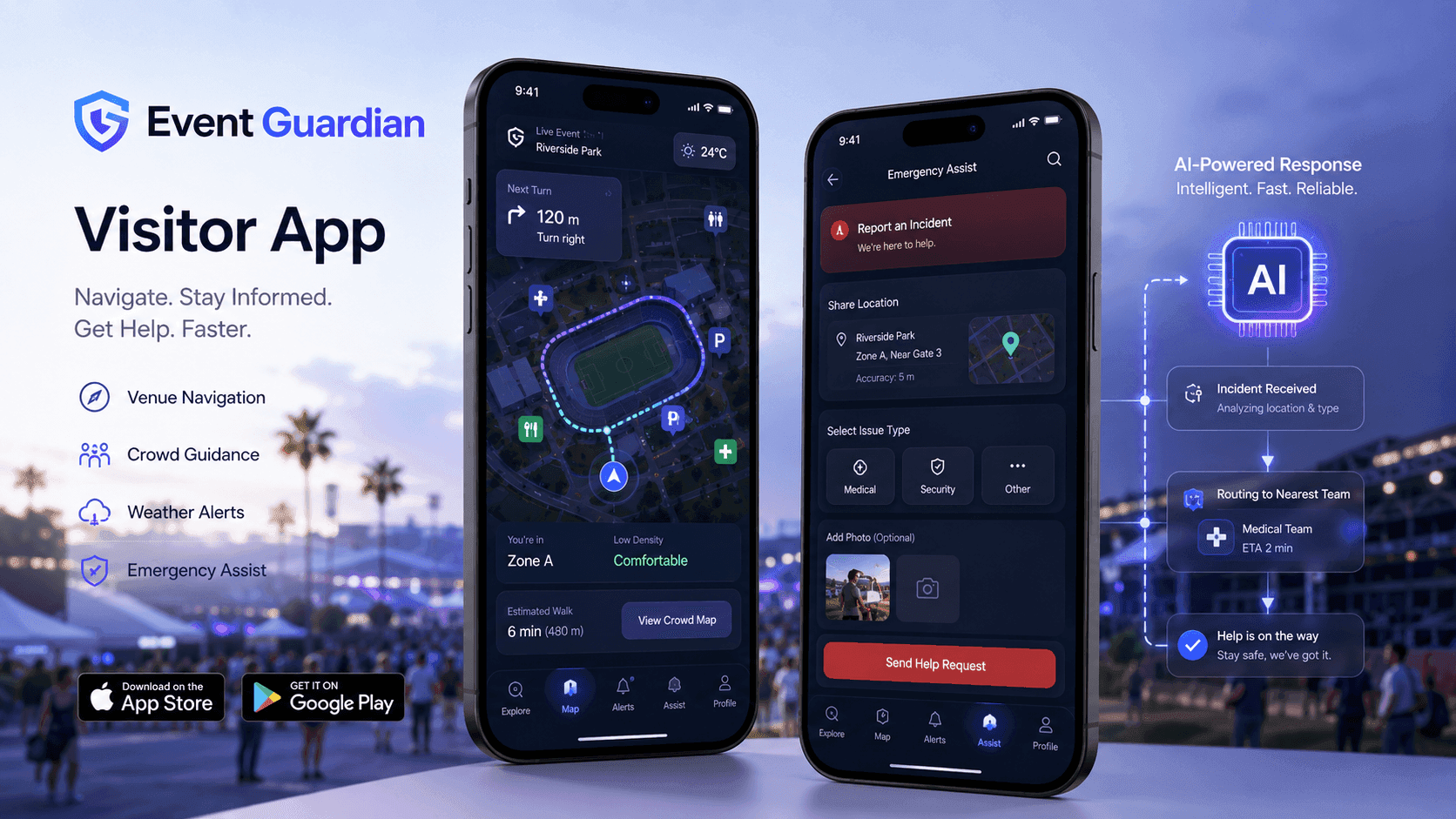
Functions
With voluntary consent
Privacy principles
Emergency call and AI-assisted initial assessment
Visitors can report an incident via the app. The AI helps structure and prioritise the report — it does not replace a medical professional.
A report can contain
Possible position sources
Possible visual cues
Possible follow-up questions
Important
Automatic dispatch routing
Event Guardian identifies the professionally suitable and fastest-available team and generates a complete dispatch order.
Event Guardian knows
A dispatch order contains
Medical team 2 is being dispatched to zone B7. Security team 4 secures the access. Estimated arrival time: three minutes.
Learning from every event
Event Guardian compares plan and reality and makes the insights usable for the next event.
What is evaluated
Examples of insights gained
Every event generates knowledge. Event Guardian makes that knowledge usable for the next event.
Benefits
Event Guardian delivers value for organisers, visitors and response teams alike.
Event types
From festivals to large municipal events — Event Guardian scales with the complexity.
Privacy, security and human control
Event Guardian supports incident and event command — and keeps humans in the decision.
Event Guardian supports incident and event command. The platform does not replace medical, regulatory or safety-related decisions.
Open and sovereign platform
Event Guardian is built for openness and independence and integrates with existing systems.
Event Guardian combines planning, real-time monitoring, dispatch and knowledge management in one shared platform.
We will get back to you shortly with an appointment.